

How Can Dog Owners Tell Whether a “Pet-Friendly” Home in Dunedin, Florida Is Actually Pet-Compatible?
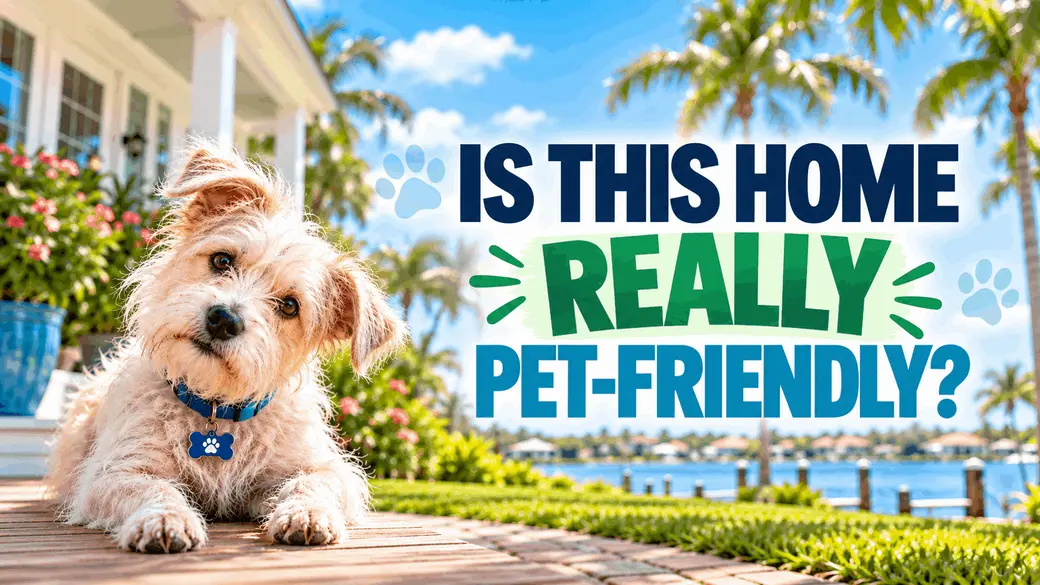
A home can allow pets and still be a poor fit for your dog. In Dunedin, Florida, pet compatibility depends on much more than whether the listing says pets are permitted; buyers should also evaluate community rules, flooring, stairs, outdoor access, fencing, walkability, evacuation planning, and whether the property actually supports the way their dog lives every day.
That distinction matters because Dunedin has a strong dog-friendly identity. Honeymoon Island State Park has a designated pet beach and allows dogs in designated areas, including the nature trail, when kept on a six-foot hand-held leash.
But a dog-friendly town does not automatically make every property in that town dog-friendly.
That is why I look at pet-friendly housing differently.
Permission is one checkpoint. Compatibility is the decision.
A condo may permit your dog but have stairs that become difficult as the dog ages. A house may have a fenced yard but a gate that delivery drivers regularly open. A beautiful home may have slick tile that your dog struggles to navigate. And a property near the water may fit your everyday lifestyle while creating an evacuation plan you have never had to think about before.
The better question is not simply, “Can my dog live here?”
It is:
Will this home actually work for the life my dog and I live together?
Key Takeaways
- “Pet-friendly” often tells you whether a pet is permitted; it does not tell you whether the home is truly compatible with that particular pet.
- Condo and HOA rules should be verified before a buyer assumes a pet is permitted under the terms they expect.
- Flooring, stairs, outdoor access, fencing, gate security, traffic, and the pet’s age or mobility can all affect day-to-day compatibility.
- Dunedin offers real dog-friendly lifestyle amenities, including Honeymoon Island State Park’s designated pet beach, but individual homes and communities can still differ substantially.
- In Pinellas County, flood zones and evacuation zones answer different questions. Evacuation zones are based on storm-surge risk, and pet owners should understand what evacuating with their animals would actually require.
- The best pet-friendly home is not simply one that permits the dog. It is one that supports the dog’s routine, safety, mobility, and long-term needs.
Pet-Friendly Does Not Always Mean Pet-Compatible
One of the most important distinctions I make with dog owners is between permission and compatibility.
A listing may say pets are allowed.
That is useful information.
But it is only the beginning.
A community may allow one dog but restrict a second. There may be size, breed, or number limitations. Some communities may require approval or have rules buyers do not fully understand until they review the documents.
And even when the rules work, the property itself still may not.
A dog-friendly home search should consider two completely separate questions:
Are my pets permitted here?
and
Does this home actually work for them?
Those are not the same thing.
That principle became the foundation of my Scruffy Says™ Pet Compatibility Check because I wanted buyers to think beyond the checkbox that says “pets allowed.”
Not every pet-friendly home is truly pet-compatible.
Start With the Community Rules Before You Fall in Love With the Home
This is particularly important for buyers considering condos, villas, townhomes, or homes governed by an association.
Pet rules can affect:
- how many pets are permitted;
- what types of pets are allowed;
- size or weight restrictions;
- breed restrictions;
- approval requirements;
- and other community-specific limitations.
My Dog Lover’s Guide to Relocating to Dunedin emphasizes verifying the actual written rules rather than relying solely on a listing description or assumption about the community.
That matters because it is very easy to fall in love with the kitchen, the balcony, the waterfront view, or the location and only later discover that the pet rules do not fit your situation.
The time to understand those rules is before you emotionally commit to the property.
And the rules are still only one part of the compatibility question.
Does the Home Actually Work for Your Dog’s Daily Routine?
Two homes can both permit dogs and work completely differently for the same animal.
That is where the practical details start to matter.
Flooring Is More Important Than It Sounds
I have a very personal example of this.
Scruffy is used to carpet.
Put him in a home with slick tile and he suddenly looks like he has forgotten how brakes work. He gets moving, starts sliding, and ends up skidding across the floor.
It is funny to watch when you are visiting someone.
It is a different question if that is going to be the dog’s everyday environment.
For some dogs, slick tile or polished flooring may make movement more difficult, especially as they age or develop mobility issues.
But carpet creates the opposite problem for other pets.
If you have an older dog, a puppy, or a pet that occasionally has accidents, carpet can become much harder to maintain than tile, luxury vinyl, or another easy-to-clean surface.
There is no single flooring material that is universally “best for dogs.”
The better question is:
Does this flooring work for my dog?
That is the kind of detail buyers rarely see in a listing description, but it can have a real effect on everyday life.
Stairs and Interior Layout
Stairs may not matter at all to a healthy younger dog.
Years later, they can matter a great deal.
A buyer with a senior dog—or a breed prone to mobility issues—may want to think differently about:
- multi-story living;
- stairs to get outside;
- elevators in condo buildings;
- slippery stair surfaces;
- where the pet sleeps;
- and how easily the dog can move through the home.
I do not think buyers should purchase a house based solely on what their dog might need someday.
But when two homes are otherwise good choices, thinking ahead can prevent a property feature from becoming a daily problem later.
Outdoor Access Is More Than Having a Yard
A yard can look fantastic in listing photos.
For a dog owner, I want to know how it actually functions.
Can the dog get outside easily?
Is the yard secure?
Is it usable during Florida’s hotter months?
Is there shade?
Does the dog have to cross a pool deck or other slippery surface to reach the grass?
Is the outdoor area private, shared, fenced, or exposed to traffic?
For a dog that needs to go outside frequently—or an aging pet that cannot comfortably take a long walk every time it needs a bathroom break—those questions can matter more than the size of the yard itself.
A Fenced Yard Is Only as Secure as the Gate
Dog owners often put “fenced yard” high on their wish list.
That makes sense.
But I also want buyers to think about how that fence interacts with everyday life.
A yard may have perfectly adequate fencing and still create escape opportunities if the gate is regularly accessed by:
- delivery drivers;
- landscapers;
- pool service;
- contractors;
- meter readers;
- guests;
- or other vendors.
With the volume of home deliveries many households receive now, this is not a theoretical problem.
I know dog owners whose pets seem to discover an open gate almost every time someone comes onto the property.
So when I look at fencing with a pet owner, I am not only looking at the panels.
I am looking at:
- the gate latch;
- whether the gate self-closes;
- whether someone can easily leave it partially open;
- whether the household can see the gate from inside;
- and who is likely to need regular access to the yard.
A fenced yard is not truly secure if the gate cannot reliably stay closed.
That is a small detail with potentially very large consequences.
Walkability Should Be Evaluated From the Dog’s Perspective Too
Dunedin is often associated with walkability and outdoor activity, and for many dog owners that is part of the attraction.
But “walkable” means different things depending on the dog.
A healthy, high-energy dog may love a long walk through the neighborhood.
A senior dog may need shorter routes.
A reactive dog may struggle on a busy pedestrian corridor.
A short-nosed breed may need more careful heat management.
A small dog may be comfortable in places a much larger dog is not.
So I encourage buyers to look beyond whether the neighborhood has sidewalks.
Ask:
- Is there shade?
- How busy is the road?
- How much pavement is exposed to the sun?
- Where will we walk in July?
- Are there nearby green spaces?
- Can we reach them safely?
- What will our routine actually look like at 7 a.m., 3 p.m., and 10 p.m.?
The best neighborhood for a dog is the one that supports that dog’s real routine—not the one with the best marketing description.
Dunedin’s Dog-Friendly Lifestyle Is Still a Real Advantage
None of this is meant to downplay the reason dog owners are often drawn to Dunedin.
There are legitimate pet-oriented lifestyle features here.
Florida State Parks says Honeymoon Island State Park has a designated pet beach on the southern tip of the island and allows dogs in designated areas, including the nature trail, when kept on a six-foot hand-held leash.
The City of Dunedin notes that dogs are not permitted on the Dunedin Causeway beach itself, but leashed dogs are permitted on the Pinellas Trail along the Causeway.
That distinction is another good example of why details matter.
“Dog-friendly” does not mean dogs can go everywhere.
And a community can have an extremely dog-friendly culture while individual properties, associations, or locations still require closer examination.
That is why I want buyers to enjoy the lifestyle and investigate the logistics.
Flood Zone and Evacuation Zone Are Not the Same Thing
This may be the single most important Florida-specific conversation I have with relocating pet owners.
A flood zone and an evacuation zone answer different questions.
Pinellas County explains that flood zones, evacuation zones, and storm surge are different. Flood zones are used to assess flood risk, while evacuation zones are based on ground elevation and vulnerability to hurricane storm surge.
That distinction surprises a lot of people who are new to coastal Florida.
And for someone with pets, I think it matters even more.
When I am helping a relocating dog owner evaluate a property, I do not want to ask only:
What flood zone is this house in?
I also want to ask:
What evacuation zone is it in—and what would leaving with your pets actually look like?
That second question changes the conversation.
What Would Evacuating With Your Dog Actually Require?
Pinellas County Emergency Management tells residents that if they are ordered to evacuate, they should take their pets with them rather than remain at home because of their animals. The county has multiple pet-friendly shelters, although not every shelter opens for every storm.
But knowing that pet-friendly shelters exist is not the same thing as having a plan.
A dog owner should think ahead about:
- Where would you go?
- Do you have family or friends outside the evacuation area?
- Which hotels could accommodate your animals?
- Are you evacuating with one dog or several?
- Does your dog travel well?
- Do you have an appropriately sized crate or carrier?
- Does your pet need medication or special food?
- How quickly could you load your pets and supplies into the vehicle?
- What happens if you need to leave during heavy traffic?
- Would the destination you have chosen also be outside the evacuation area?
Pinellas County recommends planning pet-friendly accommodations in advance. At county pet-friendly shelters, dogs and cats are housed separately from their owners in crates or carriers, and owners must bring an appropriately sized crate or carrier.
That is exactly why I think pet owners should consider evacuation logistics when they buy, not the first time a hurricane is approaching.
A beautiful coastal location can still be the right choice.
The point is to understand what owning there requires.
Think About the Dog You Have Now—and the Dog You May Have Later
Pet compatibility changes over time.
The dog that races up a staircase today may not want anything to do with those stairs ten years from now.
The dog that happily walks two miles every morning may eventually need a much shorter route and easier access outside.
That is why one part of my Scruffy Says™ Pet Compatibility Check is Usability Over Time.
Buyers may want to consider:
- stairs;
- elevators;
- flooring traction;
- outdoor access;
- distances to relief areas;
- balcony versus yard living;
- and whether the home can continue to work if the pet’s mobility changes.
This is especially important when buying a home you expect to stay in for a long time.
Your Pet’s Lifestyle Matters
There is no universal pet-compatible property because there is no universal dog.
A young, energetic dog may need a completely different environment from a senior dog.
A reactive dog may benefit from more private outdoor space.
A small companion dog may thrive in a condo that would be frustrating for a larger, high-energy breed.
A household with three dogs has different needs from a household with one.
That is why I do not think pet-friendly real estate should start with a generic checklist.
It should start with the pet.
What is the dog’s:
- energy level;
- size;
- age;
- temperament;
- mobility;
- daily routine;
- tolerance for other dogs or people;
- and likely needs over time?
Then we can ask whether the home supports that lifestyle.
My Scruffy Says™ Pet Compatibility Check
I created the Scruffy Says™ Pet Compatibility Check to give pet owners a more complete way to think about a housing decision.
The framework looks at seven areas:
S — Space & Layout
Does the interior layout, flooring, stair configuration, and usable space work for the pet?
C — Community Rules
Are the pets actually permitted under the association or community rules?
R — Recreation & Routine
Does the surrounding area support the walks, parks, outdoor time, and everyday routine the pet needs?
U — Usability Over Time
Will the home still work as the pet ages or mobility changes?
F — Fencing & Safety
Are fences, gates, balconies, pools, traffic exposure, and other safety considerations appropriate?
F — Florida Realities
What do heat, storms, flood risk, evacuation planning, and local wildlife mean for the pet?
Y — Your Pet’s Lifestyle
Does this particular home fit this particular animal?
The purpose is not to make the housing search more complicated.
It is to catch the practical issues that are easy to miss while you are focused on kitchens, bathrooms, square footage, and price.
A Pet-Compatibility Check Before You Make an Offer
Before deciding that a Dunedin property is truly pet-friendly, I would want a dog owner to be able to answer these questions:
- Are my pets permitted under the actual community rules?
- Are there limits on number, size, breed, or approval?
- Does the flooring work for my dog?
- Are stairs or elevators an issue now or potentially later?
- How easy is it to get outside?
- Is the yard truly secure?
- Can delivery drivers or service providers access the gate?
- Does the neighborhood work for our normal walking routine?
- Is there adequate shade and a realistic plan for Florida heat?
- What flood zone is the property in?
- What evacuation zone is it in?
- Where would I go with my dog if an evacuation were ordered?
- Do I have the transportation, crate, medication, food, and supplies needed to leave?
- Will this home still work if my dog’s mobility changes?
- Does this property fit the dog I actually have—not an imaginary “average pet”?
If the answers work, then “pet-friendly” starts becoming something more meaningful.
It becomes pet-compatible.
Frequently Asked Questions
Are all condos in Dunedin pet-friendly?
No. Pet rules vary by condominium and community, and buyers should review the applicable written restrictions before assuming their dog will be permitted. A listing that says pets are allowed may not communicate every rule that applies to size, number, breed, or approval.
Is Dunedin a good place to live with a dog?
Dunedin offers several dog-friendly lifestyle features, including a designated pet beach and dog-permitted areas at Honeymoon Island State Park.
Whether a particular home is a good fit still depends on the dog, property, location, community rules, and daily routine.
If you are also trying to decide how Dunedin compares with nearby communities from a broader lifestyle perspective, my guide to Dunedin vs. Palm Harbor vs. Safety Harbor looks at those differences from a relocation standpoint.
What should dog owners check before buying a condo?
Start with the written pet restrictions, then evaluate stairs or elevators, flooring, access to outdoor relief areas, nearby walking routes, parking and entry logistics, evacuation planning, and how the property will work as the dog ages.
What is the difference between a flood zone and an evacuation zone?
A flood zone relates to flood risk and can have insurance implications. An evacuation zone is based on storm-surge risk and is used by local officials to determine which areas may need to evacuate when a storm threatens. Pinellas County recommends understanding both.
Should I avoid buying a home in an evacuation zone if I have pets?
Not necessarily.
Living in an evacuation zone is a planning consideration, not an automatic reason to reject a property. The important question is whether you understand the zone and have a realistic plan for leaving with your pets if an evacuation is ordered.
Pinellas County provides a Know Your Zone lookup and pet-specific emergency planning resources that buyers can use before making that decision.
Final Thoughts
Dunedin can be a wonderful place to live with a dog.
But a dog-friendly community and a pet-compatible home are not the same thing.
A property can permit your dog and still create problems with flooring, stairs, outdoor access, gate security, walking routes, evacuation logistics, or the dog’s changing needs over time.
That is why I come back to one simple distinction:
Permission is one checkpoint. Compatibility is the decision.
The best pet-friendly home is not simply the property where the rules say your dog can live.
It is the property where the home, the community, the Florida realities, and your pet’s actual lifestyle work together.
And if you are relocating to Dunedin, the community itself is only part of the decision. The property still has to work for both of you.
If you are planning a move to Dunedin with a dog, I am happy to help you look beyond the listing and evaluate whether a property truly fits the way you and your pet live.
Strategic Guidance. Exceptional Outcomes.
Recent Posts



Have a question about buying or selling? Tell me what's on your mind and I'll be in touch.
Let's Talk About Your Next Move